


Synthetic Materials for the Feather Shed

Synthetic materials: when technology meets the art of assembly
For generations, fly tiers have built their reputation on the use of natural feathers, hair, and fur. These materials remain essential today and continue to produce some of the most beautiful flies in the world.
But in recent decades,synthetic materials have opened up a whole new world of possibilities.

Holographic reflections, UV fibers, phosphorescence, improved movements, increased strength and exceptional durability: modern synthetic materials make it possible to create flies that are more visible, more attractive and often more effective than ever before.
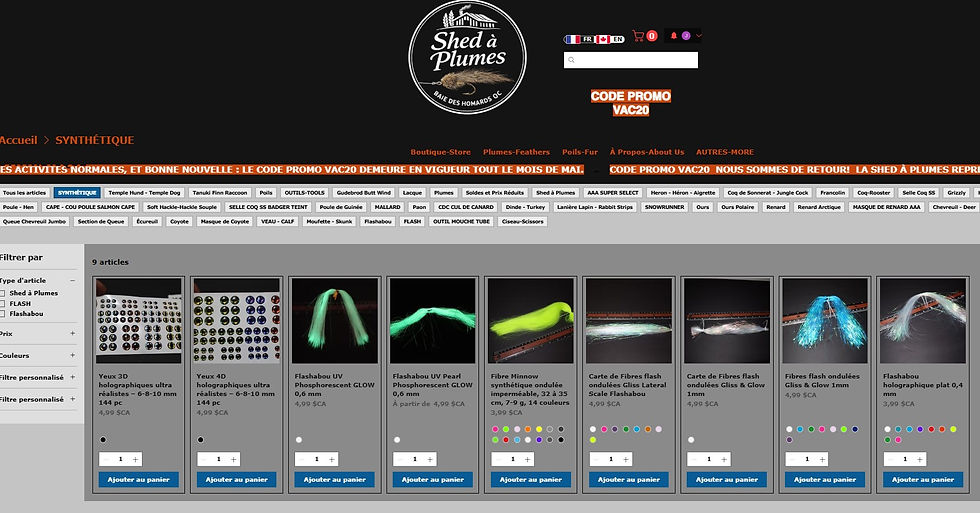
At La Shed à Plumes , we select quality synthetic materials that perfectly complement natural materials to offer fly tiers the best of both worlds.
Why are synthetic materials so effective?
In nature, predatory fish react primarily to a few stimuli:
The light reflections.
The contrasts.
The movements.
The silhouettes.
UV signals.
Subtle color changes depending on the angle of the light.

Modern synthetic materials have been developed precisely to amplify these signals and make a fly more visible and attractive.

Flashabou UV phosphorescent glow 0.6 mm and Flashabou UV pearl phosphorescent glow 0.6 mm are materials designed to attract attention even when conditions become more challenging.

Thanks to its ability to reflect UV rays and retain a phosphorescent effect after exposure to light, it continues to produce a noticeable glow in deep, tinted waters or on cloudy days.

Just a few fibers are enough to bring life to a streamer wing, a salmon fly tail, or an imitation intended for predators.

UV fibers for streamers and intruders
Modern UV fibers allow for the addition of an extra dimension to the assemblies.
Unlike conventional fibers, they reflect certain wavelengths present in the aquatic environment more effectively. The result is a fly that remains visible even when the light diminishes or the water becomes darker.
These fibers are particularly valued for:
Trout streamers.
Salmon and steelhead intruders.
Pike flies.
Rigs intended for striped bass.
They also allow for the creation of depth and transparency effects that are impossible to achieve with traditional materials.
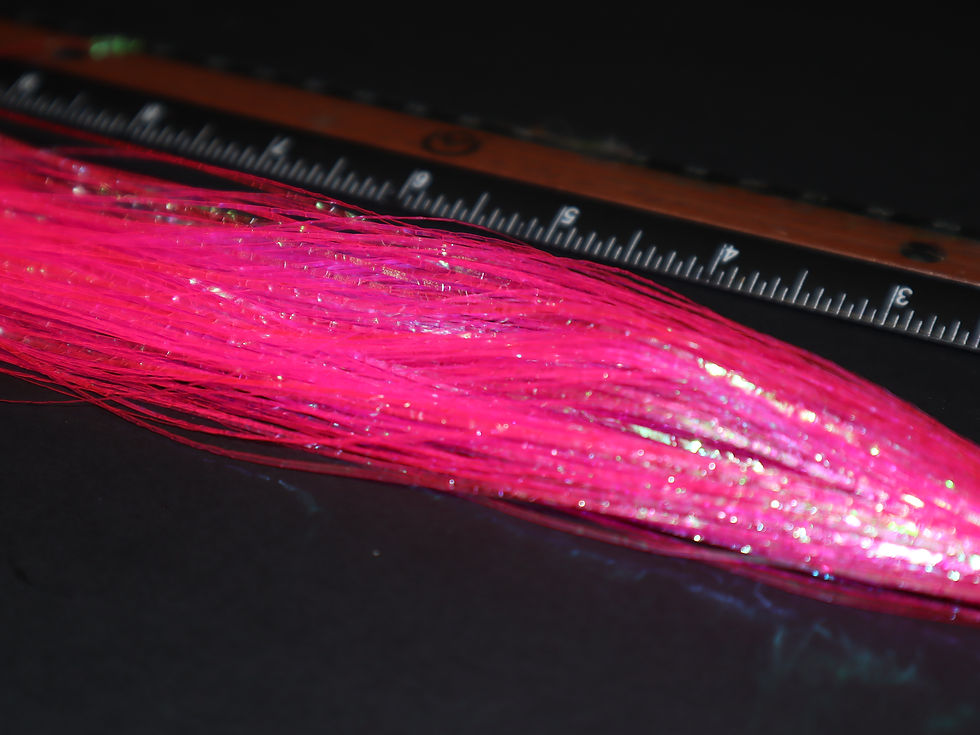
The Lateral Scale Flashabou remarkably imitates the reflections produced by the scales of a baitfish.
Spécifications
Largeur : 0,7 à 1 mm (0,028" à 0,039")
Longueur : environ 28 à 30 cm (11,02" à 11,81")
Poids par paquet : 7 à 8 grammes
Its unique texture and pearly reflections produce changing flashes that perfectly reproduce the movements of an injured or fleeing fish.

In water, each fiber acts like a small reflective scale that captures and diffuses light from multiple angles.

It is a material of choice for modern streamers designed to:
With Atlantic salmon.
With trout.
With pike.
With muskellunge.
At the striped bar.

Holographic flat tinsel remains one of the most versatile materials in the world of editing.

A flat, thin, highly reflective synthetic flash material designed to add brilliance, movement, and attractive highlights to fly wings, tails, and bodies. Its holographic finish catches light from various angles, even in low light. Ideal for tying salmon, steelhead, trout, and other flies requiring a realistic and long-lasting flash effect.

Modern holographic versions create multidirectional reflections that constantly change depending on the angle of the light and current.

Whether for traditional salmon flies, streamers or patterns intended for sea fishing, flat tinsel retains its place among the most effective materials ever created.

Wavy, flashy synthetic fibers designed to add brilliance, movement, and volume to fly patterns. Their waffle texture creates multidirectional reflections that mimic the natural flashes of baitfish.

Thanks to their Gliss & Glow effect , they offer excellent underwater visibility, even in low-light conditions. Ideal for the wings, tails, and bodies of salmon, steelhead, and trout flies. Soft, lightweight, and easy to incorporate into all types of fly patterns.

3D Holographic Eyes & 4D Holographic Eyes : The Finishing Touch

If there is one detail capable of completely transforming a fly or streamer, it is the eyes.

The 4D holographic eyes replicate the three-dimensional appearance of a baitfish's natural eyes.

Numerous studies on predator behavior demonstrate that the eyes are an important focal point when attacking prey.
Adding realistic eyes allows for:

To increase realism.
To improve the overall profile of the lure.
To create a natural point of attack.
To add reflections visible from afar.
They have become practically indispensable in modern streamers for pike, muskellunge, striped bass, trophy trout and several marine species.

Minnow-type synthetic fibers represent a major evolution in the design of modern streamers.

Their slightly wavy, waterproof texture does not retain water, creates movement and allows for impressive profiles without making the fly difficult to cast.

They allow you to create realistic imitations of smelt, fry, herring or other forage fish while maintaining excellent mobility.
Length: 32 to 35 cm
Weight: 7 to 9 g
Colors: 14 colors available
Material: Corrugated synthetic fibers, completely waterproof
Use: Streamer fly tying, freshwater and saltwater fishing
Targets: Trout, pike, musky, salmon, striped bass, and many others

Tradition and innovation
The best editors know that it's not a question of choosing between natural and synthetic materials.
A Finn Raccoon wing enhanced with Flashabou UV.
A classic salmon fly embellished with a few holographic fibers.
A Minnow fiber streamer equipped with 4D eyes.
This combination often produces the most effective flies.
At La Shed à Plumes , we believe that innovation should serve the fly tyer's creativity. That's why we offer both high-end feathers and furs as well as the best-performing synthetic materials available today.
Because in the end, whether it is tied with a rare feather or a state-of-the-art holographic fiber, a good fly has only one goal: to come to life in the water and convince the fish that it is real.


Comments