


Protect the Salmon—or Fill the Rivers with Anglers?

13,620 Licences, 49,458 Fishing Days, and 13,133 Salmon Counted: Where Is the Limit?
Editorial on Salmon Fishing Pressure in Quebec in 2025
The 2025 Atlantic salmon report for Quebec calls for a discussion that goes far beyond the simple question of fishing success. It forces us to ask whether the way we use, manage, and promote salmon rivers is still appropriate given the current condition of the resource.

For the 2025–2026 season, 13,620 salmon fishing licences were sold in Quebec: 11,486 to residents and 2,134 to non-residents. These sales include annual licences, three-day licences, and mandatory catch-and-release licences. The figures are identified as preliminary. [1]
During the 2025 fishing season, river use amounted to 49,458 fishing days. At the same time, 13,133 adult salmon were observed migrating upstream in the 34 rivers where counts were conducted. [2]
These figures cannot be compared as though they represent exactly the same people, fish, and rivers. Even so, placing them side by side raises a legitimate question:
How much pressure can a declining salmon population still withstand?
Main Results for 2025
Indicator | Result | Clarification |
Salmon fishing licences sold | 13,620 | Number of licences, not necessarily unique anglers |
Licences sold to residents | 11,486 | Includes all salmon licence categories |
Licences sold to non-residents | 2,134 | Includes all salmon licence categories |
Fishing activity | 49,458 fishing days | Full or partial days spent fishing |
Adult salmon observed | 13,133 | Counted in 34 rivers |
Reported catches | 10,918 | Fish retained and released |
Reported releases | 10,016 | A minimum because reporting is not mandatory |
Salmon retained | 902 | 680 small salmon and 222 large salmon |
Proportion released | 92% | Share of reported catches |
Decline in total returns | 45% | Compared with the previous five-year average |
Decline in multi-sea-winter salmon | 68% | Salmon that spent more than one winter at sea |
Increase in grilse | 10% | Salmon that spent one winter at sea |
A Contrast That Is Difficult to Ignore
At first glance, the contrast is striking: 13,620 licences sold versus 13,133 salmon counted.
However, it would be incorrect to claim that there were more anglers than salmon across Quebec as a whole.
First, one licence does not necessarily represent one different person. Some licences can be combined, and one individual may purchase more than one licence during a season. [3]
Second, the 13,133 salmon were counted in only 34 rivers, while Quebec has 114 waterways officially designated as salmon rivers. The count therefore does not represent every salmon that returned to the province. [2]
Third, the 10,918 reported catches do not necessarily represent 10,918 different fish. The same salmon may be caught, released, and caught again.
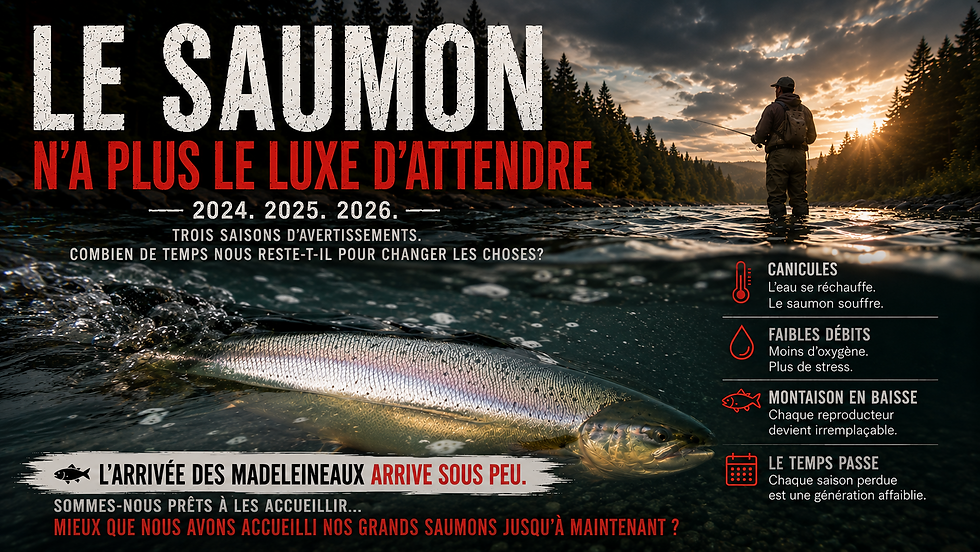
These clarifications prevent an overly simplistic comparison. They do not, however, eliminate the underlying concern: substantial fishing pressure is still being placed on the rivers at a time when salmon returns are falling sharply.
Nearly 50,000 Days of Presence on the Rivers
The number of licences provides an indication of the popularity of salmon fishing. The number of fishing days gives a better picture of the pressure being exerted on the rivers.
In 2025, 49,458 fishing days were recorded. That represents about 3.6 fishing days per licence sold, although this average does not account for people holding multiple licences or those who purchased a licence but did not use it.
Of course, not every fishing day results in a catch. Many anglers finish the season without catching a single salmon. Even so, nearly 50,000 fishing days represent thousands of hours spent casting flies into pools where salmon rest before spawning.
Across the province, that pressure may appear widely distributed. On a smaller river where only a few dozen or a few hundred salmon return, it can become significant.
Catch-and-Release Does Not Eliminate All Impacts
Catch-and-release is an important conservation measure. In 2025, 10,016 of the 10,918 reported catches were released, representing 92% of all reported catches. Only 902 salmon were retained. [2]

A salmon released properly can continue its migration and reach the spawning grounds. However, catch-and-release is never completely without consequence.
Since 2015, the ministry has applied an estimated 7% mortality rate to released salmon in its management calculations. This is intended to avoid overestimating the number of spawning fish remaining in the rivers. [2]
Applied theoretically to the 10,016 reported releases in 2025, that rate would represent approximately:
701 potential deaths.
This does not mean that 701 dead fish were found. It is a theoretical estimate based on the mortality rate used by the ministry.
Other effects may also occur, including exhaustion from the fight, injuries, handling, time spent out of the water, repeated captures, and the additional stress caused by warm water.
The report also states that reporting released fish is not mandatory. The figure of 10,016 therefore represents a minimum. [2]
The Decline of Large Salmon
The 68% decline in multi-sea-winter salmon is probably the most alarming result in the 2025 report.
Multi-sea-winter salmon have spent more than one winter at sea. They are generally larger and include a higher proportion of females than grilse. Their contribution to reproduction is therefore especially important. [2]

A decline in large salmon does not simply mean fewer prized fish for anglers. It may also mean fewer eggs deposited and a reduced ability for populations to renew themselves.
When large females become rare, every fish that reaches the spawning grounds becomes even more biologically valuable.
The question should therefore not be limited to whether a large salmon can survive after being caught. We must also ask whether some populations should be disturbed less in the first place.
A Contradiction in Our Approach
Salmon fishing has genuine cultural, social, and economic value. It supports guides, outfitters, river managers, businesses, and many regional communities.

Anglers are also often among the strongest defenders of salmon rivers and salmon habitat.
It would therefore be unfair to present anglers as the sole cause of the decline. Salmon face many pressures: climate change, warming water, low flows, marine conditions, habitat loss, predation, and other human activities.
Sport fishing is not the only cause of declining salmon populations. It is, however, one of the pressures Quebec can regulate directly and immediately.
While salmon returns are falling, organizations continue to offer mentorship programs, workshops, and promotional activities designed to attract new anglers.

Training new participants is not inherently wrong. A well-trained angler can become a stronger advocate for salmon and adopt better handling practices.
But one contradiction remains:
Can we continue recruiting more and more anglers without first determining how much pressure the rivers can truly withstand?
We cannot describe the state of salmon as alarming while continuing to expand participation as though the resource were still abundant.
Managing Fishing Effort, Not Only Harvest
For many years, salmon management focused mainly on how many fish could be retained.
As populations declined, catch-and-release became the main solution. But replacing harvest with release does not necessarily solve the entire problem if the number of captures and the overall fishing pressure remain high.
A broader strategy could include:
seasonal limits on the number of releases per angler;
limits on the number of fishing days allowed on vulnerable rivers;
automatic closures when water temperatures reach critical levels;
refuge pools or river sections where fishing is prohibited;
reduced promotion of rivers with critically low populations;
management adapted to each individual population;
mandatory reporting of catches and releases;
a better system for counting unique anglers.
The goal would not necessarily be to end salmon fishing. It would be to ensure that fishing practices evolve in step with the condition of the resource.
Changing How We Define Success
The success of a fishing season should no longer be measured only by the number of catches, the catch rate, or angler satisfaction.
A successful season should also be one in which:
more salmon reach the spawning grounds;
large females are protected;
repeated captures are reduced;
temperature-related closures happen quickly;
weakened populations begin to recover.
The best fishing season may no longer be the one in which the greatest number of salmon are caught.
It may be the one in which the greatest number of salmon are left undisturbed.
Conclusion
The 2025 figures do not allow us to claim directly that there is one angler for every salmon. Licences do not necessarily represent unique individuals, the salmon count covers only 34 rivers, and the same salmon may be caught more than once.
But the contrast remains troubling:
13,620 licences sold;
49,458 fishing days;
10,918 reported catches;
13,133 salmon counted in monitored rivers;
a 45% decline in total returns;
a 68% decline in multi-sea-winter salmon.
The question is no longer simply:
How many salmon can we still catch?
It should now become:
How many salmon must we leave completely undisturbed to secure their future?
And above all:
With so few salmon, is there still room for ever more anglers?
Sources
[1] Government of Quebec — Fishing Licence Sales.Preliminary 2025–2026 figures for annual, three-day, and mandatory catch-and-release salmon licences, broken down between residents and non-residents.
[2] Quebec Ministry of the Environment, the Fight Against Climate Change, Wildlife and Parks.Salmon Harvest in Quebec — 2025 Report. Data on salmon returns, catches, releases, fishing days, five-year comparisons, and the mortality rate applied to released fish.
[3] Government of Quebec — Obtaining a Sport Fishing Licence.Description of licence categories, resident and non-resident rules, and conditions governing the use and combination of licences.


Comments