


Atlantic Salmon in Peril: When Today's Harvests Erase Tomorrow's Rights

Subsistence fishing, recreational fishing, and Atlantic salmon: we must have the courage to talk about it
Talking about subsistence fishing, recreational fishing, and Aboriginal rights in Canada is not simple. It's a sensitive subject. There's history involved. There are rights, traditions, wounds, and social and cultural realities that cannot be dismissed out of hand.

But there is also another reality that we can no longer avoid: Atlantic salmon are disappearing from several of our rivers.
And when a species declines like this, silence protects no one. It doesn't protect the fishers. It doesn't protect the communities. And most importantly, it doesn't protect the salmon. We can respect ancestral and treaty rights without turning a blind eye to the state of the resource. We can respect Indigenous communities without refusing to discuss harvesting. We can also ask recreational fishing to make an effort without pretending it's solely responsible for the problem.
Conservation begins when we are able to look at everything head-on.
Atlantic salmon populations are not declining due to a single factor. There is the ocean, climate change, warm water, damaged habitats, predators, lack of forage fish, dams, bycatch, and direct harvesting.

But precisely because the salmon are being attacked from all sides, each death becomes more significant. When there are many salmon, a river can withstand a certain amount of pressure. But when returns are low, every salmon removed from the river counts. A dead salmon doesn't spawn. A female that doesn't return to the gravel won't lay her eggs. It's as simple as that.
Recent scientific data shows that the situation is serious. The ICES/WGNAS 2026 report indicates that returns of virgin 2SW salmon to North America—that is, large salmon returning after two winters at sea—were in 2025 the lowest in the 56-year historical record. This is not a minor alert. It is a major signal. [1]

Meanwhile, we often continue to talk about Greenland as if the major pressure comes primarily from outside. Yes, Greenland needs to be part of the discussion. Yes, this fishery has an impact. But if we want to be honest, we also need to look at what's happening here in Canada.
In 2025, data submitted to NASCO indicated that the retained catch in Canada was 81.1 tonnes , while Saint-Pierre-et-Miquelon was at 1.5 tonnes . For Greenland, ICES indicated that the total reported catch in 2025 was 29.9 tonnes , with 28.9 tonnes in western Greenland and 1.0 tonne in the east . [2][3]

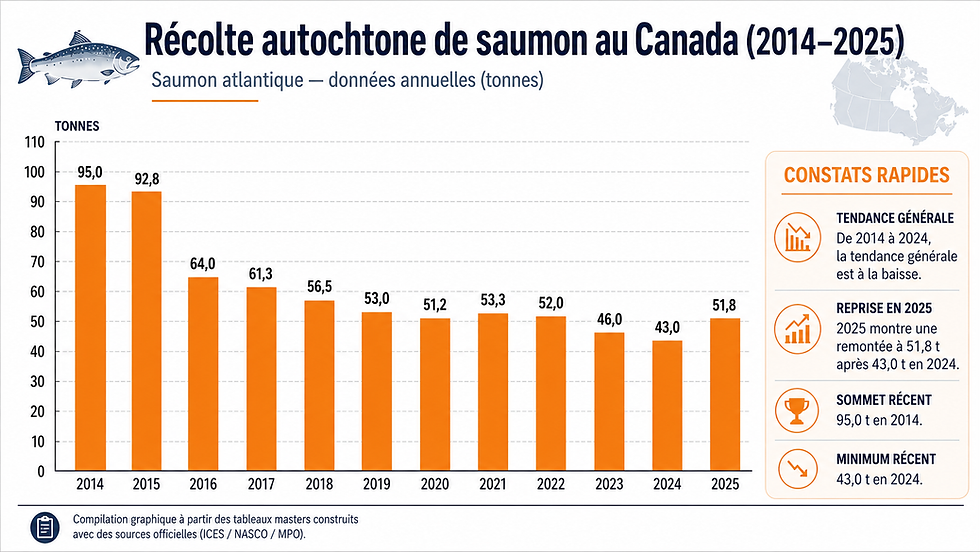
When data from 2014 to 2025 are combined from ICES/WGNAS reports, NASCO statistics, and government records, the picture is clear. The Indigenous/FSC harvest in Canada represents approximately 719.9 tonnes . The conserved recreational fishery in Canada represents approximately 602.0 tonnes . The reported harvest in Greenland represents approximately 370.9 tonnes .
Therefore, from 2014 to 2025, the combined Indigenous/FSC and recreational harvest conserved in Canada represents approximately 1,321.9 tonnes . This is about 3.56 times the declared harvest from Greenland over the same period.
This isn't meant to point fingers. It's not meant to blame any group. It's meant because the numbers speak for themselves. And if we truly want to protect salmon, we must be able to listen to what the numbers say.
Even in 2025, a year in which the conserved recreational fishery declined significantly, the picture remains striking. The data used indicates 51.8 tonnes for the Indigenous/FSC harvest in Canada, 28.1 tonnes for the conserved recreational fishery in Canada, and 29.9 tonnes for the Greenland harvest.
Together, the indigenous/FSC harvest and the conserved recreational fishery in Canada therefore represent 79.9 tonnes in 2025. This is about 2.67 times the declared harvest of Greenland that same year.
In Quebec, the situation is even harder to accept. Historical data from the Quebec fishery shows that the total catch reached 51,299 salmon in 1988. By 2025, it had plummeted to 4,617 salmon . That's a drop of approximately 91% . You can look at it any way you want, but a 91% decrease is not a small change. It's not just a bad year. It's a wake-up call.
Commercial salmon fishing has been eliminated in Quebec for several decades. Recreational fishing has been restricted. Catch and release has become much more common. Regulations have tightened in many rivers. Yet, salmon populations continue to decline.
In 2025, in Quebec, the conserved sport fishery represents 902 salmon . Meanwhile, the ARS/FSC harvest represents 3,715 salmon . This means that the ARS/FSC harvest represents approximately 4.1 times the conserved sport fishery harvest in Quebec in 2025. [4]
Again, we mustn't conflate everything. Subsistence fishing and recreational fishing are not the same thing culturally, socially, or legally. The realities are not the same. The rights are not the same. But biologically, the result is the same: a salmon that is caught will not spawn.
This is where Aboriginal rights and the Marshall II decision become important. Indigenous and treaty rights are protected by section 35 of the Canadian Constitution. These rights are real. They are important. They must be respected. Fishing for food, social, and ceremonial purposes, often referred to as FSC or ARS, is a protected collective right. DFO clarifies that this is not an individual right, and that fish caught in this context serve the food, social, or ceremonial needs of the community. DFO also indicates that this fishery does not provide an opportunity to sell the catch. [5]
In Quebec, the DFO also reiterates a very important point: the right to fish for food, social, and ceremonial purposes takes precedence over other users of the resource after conservation . This is the heart of the debate. After conservation. Not before. [6]
The Marshall I decision in 1999 recognized a right under the 1760-1761 Peace and Friendship Treaties for certain First Nations, including the Mi'kmaq, Wolastoqey/Maliseet, and Peskotomuhkatiyik, to fish, hunt, and gather for a moderate livelihood . [7]
But Marshall II clarified something very important: this right is not without limits. The Supreme Court of Canada confirmed that Aboriginal and treaty rights can be regulated if such regulation is justified, particularly for conservation reasons. [8]
This is a crucial point. Marshall II doesn't say that rights disappear. It doesn't deny the existence of rights. It doesn't say that these rights aren't important. Rather, it says that a right can be limited when conservation requires it. And in the case of Atlantic salmon, that's precisely the question that needs to be asked.
At what point do we stop talking only about rights, traditions, leisure activities or habits, and start talking first about the survival of the salmon?
The same principle is found in the Sparrow ruling. This decision is fundamental because it recognizes ancestral rights, but also confirms that the State can regulate fishing when there is a justification, and that conservation is at the heart of this analysis. [9]
So the logic is simple: before sharing the salmon, we must first ensure that there are enough salmon left for the species to continue.
That's where the real question comes in: where does the salmon fit into all of this?
Is salmon simply a resource to be shared?
Is it simply a right to be exercised?
Is it just a hobby?
Is it just a tradition?
Or is it first and foremost a living species that must survive?
Because without salmon, there's nothing left to share.
Without salmon, there is no more subsistence fishing.
Without salmon, there is no more recreational fishing.
Without salmon, there is no longer a living tradition.
Without salmon, only memories and theoretical rights to a vanished resource remain.
There is no magic clause that guarantees the survival of salmon. No judgment, no law, no treaty can biologically guarantee that a species will survive if runs collapse, if the water warms, if habitats degrade, and if harvests exceed what the river can support. What does exist, however, is a basic principle: conservation must come before allocation .
Before deciding who can take salmon, we must first decide how many salmon should remain in the river to spawn. Before discussing sharing, we must discuss survival. Before discussing rights, we must discuss conservation thresholds. This is why conservation cannot be selective.
We cannot ask recreational fishing to reduce its catches, accept mandatory catch and release, close areas, respect warm water protocols and endure all the social pressure, while refusing to look at other harvests with the same seriousness.
But we also cannot pretend that ancestral rights are a mere pastime. They are not.
The problem is when we refuse to have a real discussion.
Talking about FSC or ARS samples is not being against Indigenous people.
Talking about recreational fishing is not the same as being against sport fishermen.
Talking about Greenland is not about looking for a scapegoat.
Talking about all the harvests is simply accepting that the salmon, for its part, does not engage in politics.
The salmon doesn't know if the death comes from subsistence fishing, recreational fishing, fishing in Greenland, accidental capture, or mismanagement. Dead, it doesn't spawn.
The current pace is frantic. Rivers are being closed. Quotas are being reduced. We wait for the results. We discuss poor runs. We hope the ocean will fare better next year. We talk about caution, consultation, jurisdiction, and complexity. Meanwhile, salmon numbers continue to decline. If we don't stop this pace, some rivers will become salmon rivers in name only. Poor runs will become the new normal. Temporary closures will become permanent. Young anglers will never experience what previous generations did. Communities will lose part of their identity.
And the rights themselves will become increasingly difficult to exercise, not because they will have been denied, but because the salmon will no longer be there.
That's the real danger.
A right without resources becomes an empty symbol. That's why Marshall 2 should remind us of a simple thing: recognizing a right doesn't mean ignoring resource limits. Regulating harvesting to protect a declining species isn't an attack on a right. It's sometimes the only way to preserve the possibility of exercising that right in the future.
Canada must therefore have the courage to build a clear, fair and transparent framework.
The data must be public.
The samples must be known.
Mortalities must be counted.
Conservation thresholds must be respected.
Closures must be implemented when a river can no longer sustain losses.
And all groups must be called upon to do their part when the state of the salmon demands it. We must also stop managing salmon as if each issue were separate. Greenland, Indigenous fisheries, recreational fishing, bycatch, marine conditions, predators, thermal refuges, habitats, and water temperatures are all part of the same problem.
But direct levies are among the few things that can be controlled quickly.
We won't be able to control the ocean tomorrow morning.
You can't cool a river down by snapping your fingers.
But we can decide how many salmon we let migrate upstream, spawn, and produce the next generation.
The question is not which group should bear the blame. The question is whether we are capable of acting before it is too late.
Respecting ancestral and treaty rights, yes.
Respecting the importance of recreational fishing, yes.
Recognizing the cultural value of salmon for several communities, yes.
But above all else, there is a simple truth: the salmon must first survive .
Because a river without salmon becomes a memory.
Because a right without resources becomes an empty symbol.
Because conservation that chooses its blind spots is not true conservation.
Speaking frankly about subsistence fishing, recreational fishing, Marshall 2, and the decline of salmon is not divisive. It is refusing to continue managing disappearance with half-truths.
It means accepting that respect for rights and the survival of the species must be considered together.
And this may be the first step towards changing things before Atlantic salmon also becomes a story told in the past tense.
Sources and references
[1] ICES — Working Group on North Atlantic Salmon, WGNAS 2026 Report. Main scientific report on the status of North Atlantic salmon stocks. The summary indicates that returns of virgin 2SW salmon to North America in 2025 were the lowest in the 56-year historical series. ( ICES Library )
[2] NASCO — CNL(26)43, Presentation of ICES Advice on North Atlantic Salmon Stocks to Council, 2026. Presentation used for the 2025 retained catch data for North America, including Canada 81.1 t and Saint-Pierre-et-Miquelon 1.5 t . ( NASCO )
[3] ICES — Atlantic salmon in the West Greenland Commission Area, 2026. Source used for the reported Greenland catch in 2025: 28.9 t west of Greenland and 1.0 t east, for a reported total of 29.9 t . ( ICES Library )
[4] Government of Quebec / MELCCFP — Atlantic Salmon Management Plan and Salmon Harvesting Report for Quebec, 2025 Season. Official source used for 2025 Quebec data: sport catches retained, catches released, fishing days, ARS/FSC harvest, total catches, and annual history. The Government of Quebec website refers to the 2025 report and indicates that salmon fishing is regulated according to the specific realities of each river and the salmon situation in the North Atlantic. ( Government of Quebec )
[5] DFO — Food, social and ceremonial fisheries. DFO indicates that the right to fish for food, social and ceremonial purposes is protected by section 35 of the Constitution, that it is a collective right, and that FSC fishing does not provide an opportunity to sell the catch. ( Fisheries and Oceans Canada )
[6] DFO — Indigenous Fisheries in Quebec. DFO specifies that fish caught for food, social, and ceremonial purposes cannot be sold, bartered, or exchanged, and that this right takes precedence, after conservation , over other users of the resource. ( Fisheries and Oceans Canada )
[7] Supreme Court of Canada — R. v. Marshall, 1999. Decision recognizing the right under peace and friendship treaties to fish, hunt and gather for the necessities of a reasonable subsistence. ( SCC Decisions )
[8] Supreme Court of Canada — R. v. Marshall 2, 1999. Decision clarifying that Aboriginal and treaty rights can be subject to justified regulation, including for conservation purposes. ( SCC Decisions )
[9] Supreme Court of Canada — R. v. Sparrow, 1990. Landmark decision on Aboriginal rights protected by section 35 and on the framework for justification, including the central role of conservation in the analysis. ( SCC Decisions )
Methodological note. The cumulative totals and ratios used in this editorial were calculated from official data from ICES/WGNAS, NASCO, DFO, and the Government of Quebec. The working tables serve only to group, harmonize, and compare the data. The original sources remain the official reports and documents cited above.
Cautionary note. This text is a citizen conservation and analysis editorial. It does not constitute legal advice. Any official publication directly affecting Aboriginal rights, treaty rights, or the application of Marshall II should be reviewed by someone knowledgeable in Indigenous and fisheries law.


Comments