


COMPARATIVE ANALYSIS | JULY 2026 WATER TEMPERATURE: MATANE VS NOVA SCOTIA

New section — Analysis Series
With Before the First Cast , my goal has always been to put the salmon before the fishing, to better understand our rivers, and to give anglers the tools they need to make more responsible decisions. Today, I'm adding a new, more technical subsection to the blog: the Analysis Series .

This series will go beyond the usual segments. It will serve to examine in depth publications, management decisions, scientific reports, tables, graphs and certain claims circulating in the salmon community.
Each analysis will seek to answer simple, but essential questions:
Does the message presented actually correspond to the studies? Are the data being used correctly? Do the proposed thresholds truly protect salmon? Is a distinction made between an administrative threshold and a biological threshold? What important information has been simplified, omitted, or taken out of context?
The Analysis Series will not be designed to attack any organization, river, or person. Rather, its objective will be to compare messages with available knowledge, to recognize what is done well, to highlight what needs to be nuanced, and to propose improvements where necessary.
The articles may include:
a clear context;
a point-by-point analysis;
comparative tables;
graphs;
the results of the main studies;
numbered sources;
the limits and uncertainties;
a practical conclusion for fishermen and managers.
Initial analysis: Matane versus Nova Scotia

The first publication in this new series will focus on two infographics concerning water temperature and the release of Atlantic salmon:
Matane River – ZEC Salmon vs. Nova Scotia Salmon Association
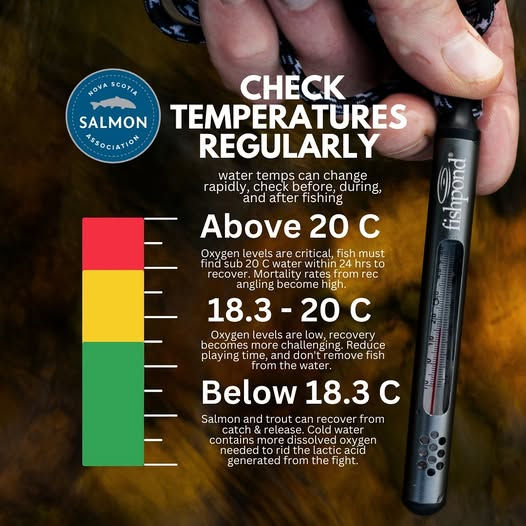
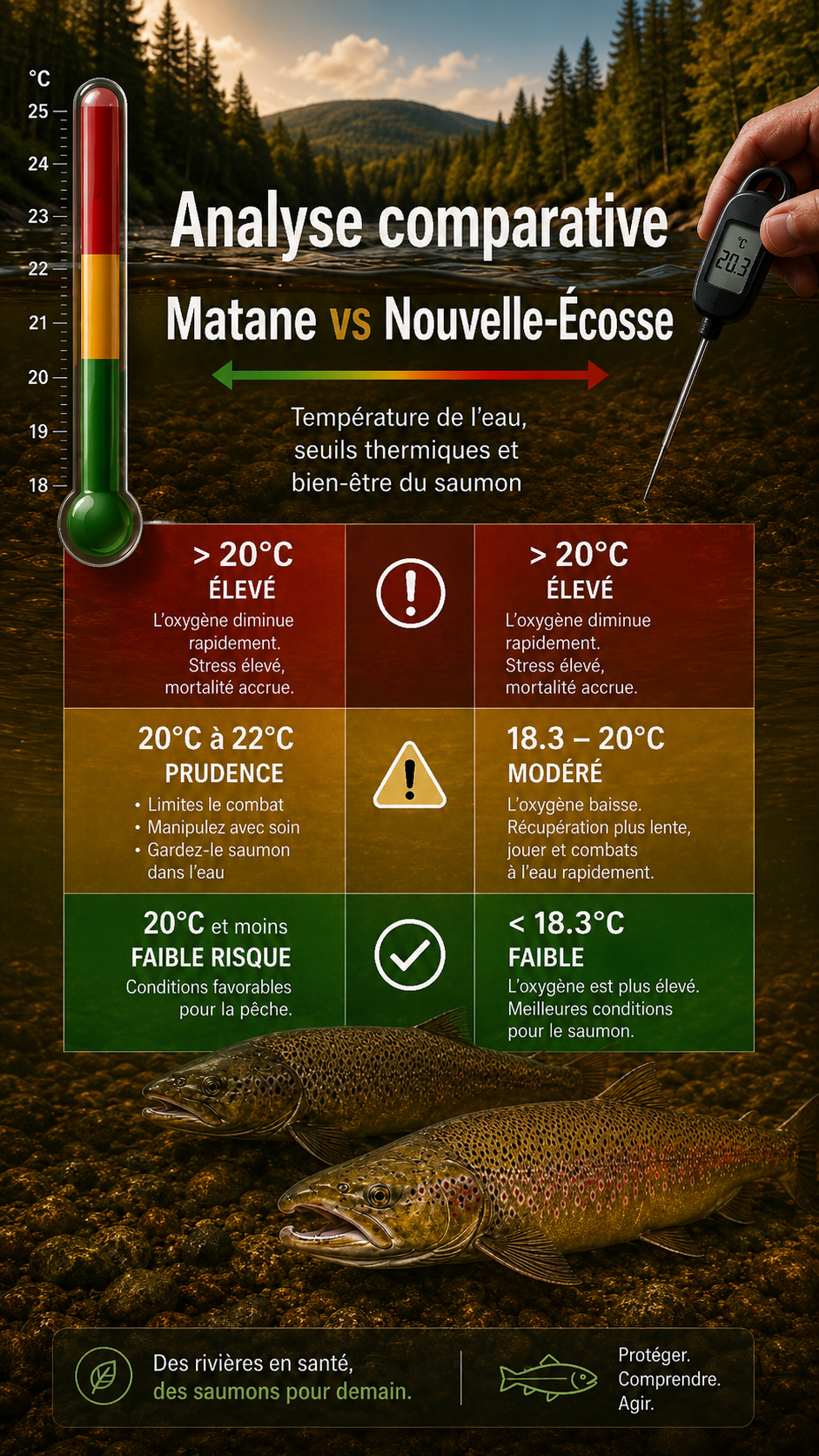
Both publications use a green, yellow and red scale, but they do not convey the same message.
In Matane, conditions are presented as favorable up to 20°C , caution is recommended between 20 and 22°C , then salmon is considered at risk from 22°C .
In Nova Scotia, caution begins at 18.3°C and the red zone begins above 20°C .
This difference of only two degrees may seem small, but for a salmon exhausted by a fight, it can represent a significant difference in its ability to recover and in its risk of mortality after being released back into the water.
The analysis will therefore compare the two messages with available studies in order to determine which best represents the actual progression of thermal risk.
Why this series?
In the world of salmon, a beautiful image or a simple message can quickly become a benchmark. But oversimplifying a complex subject can also create a false sense of security.
A salmon doesn't suddenly become vulnerable when the thermometer reaches exactly 22°C. The risk increases gradually. It depends on the temperature, the current, the duration of the fight, the injury, exposure to air, the fish's condition, and several other factors.
The Analysis Series will therefore be based on the principle of not only asking:
Is it legal to fish?
She will also ask:
Is it really responsible to fish in these conditions?
Because before the first cast, we need to understand what our decisions can mean for the salmon.
Before the first cast — Analysis Series: Understanding the data. Comparing the messages. Protecting the salmon.
Click to download the analyses
Matane vs. Nova Scotia
Matane Analysis
Nova Scotia Analysis


Comments