


Rivière aux Rochers: Behind the narrative of recovery, the figures reveal a population still devastated

Rivière aux Rochers 2026: Improvement does not equal recovery

The RiverNotes published on September 3, 2026 by the Atlantic Salmon Federation presents the Rivière aux Rochers in an encouraging light: 216 salmon were counted, compared to 114 in 2025.
Yes, 2026 is better than 2025. But when you check the reference figure, distinguish between the small salmon and the large salmon, and place this run in the historical series, the picture becomes much less reassuring.
The rigorous conclusion is simple:
2026 marks an annual improvement. The data do not yet demonstrate a recovery in the population.

A reference error that inflates the rise
RiverNotes compares the 216 salmon in 2026 to a total of 114 in 2025. However, the official report from the Ministry of the Environment, the Fight Against Climate Change, Wildlife and Parks indicates a total run of 141 salmon in 2025 :
70 madeleines;
71 red eel-marins, or large salmon;
141 salmon in total.
Comparing 216 to 114 produces an apparent increase of 89.5% .
Comparing 216 to the official total of 141 gives an increase of 53.2% .
The improvement remains real, but it does not correspond to a near doubling of the rise.

What the 2026 mounting actually contains
The final count communicated after the cage was closed is as follows:
137 madeleines ;
79 large salmon ;
216 salmon in total .
Compared to 2025, the number of madeleines increases from 70 to 137, or +95.7% .
However, the number of large salmon increased from 71 to 79, representing an increase of only 8 fish or 11.3% .
Almost the entire rebound is therefore due to the madeleines. This distinction is essential: an increase in the total does not automatically mean that the reproductive capacity of the population has been restored.
Large salmon, particularly large females, contribute significantly to egg deposition. Their numbers here remain extremely low.
One of the weakest elongations since 2000
An examination of the 2000–2026 series shows that the runs have already regularly exceeded 1,000 salmon:
1,048 in 2000;
1,064 in 2004;
1,082 in 2006;
1,571 in 2008;
1,212 in 2010;
1,624 in 2011;
1,034 in 2016.
Conversely, the last few years are among the weakest of the entire series:
252 salmon in 2023;
121 in 2024;
141 in 2025;
216 in 2026.
Of the 27 years between 2000 and 2026, only the totals for 2024 and 2025 are lower than that of 2026.
The rebound is therefore visible, but it is occurring from a historical low. It is not bringing the river back close to its previous levels.


The five-year averages show a step-like decline.
Annual fluctuations can be misleading. Five-year averages provide a clearer picture of the underlying trend.
2000–2004: 859 salmon per year ;
2005–2009: 1,024 salmon per year ;
2010–2014: 974 salmon per year ;
2015–2019: 684 salmon per year ;
2020–2024: 421 salmon per year .
This sequence shows persistent deterioration.
The average falls by 29.8% between 2010–2014 and 2015–2019, and then by another 38.4% between 2015–2019 and 2020–2024.
With 216 salmon, the 2026 run remains:
48.7% below the 2020–2024 average ;
68.4% below the 2015–2019 average ;
78.9% below the 2005–2009 average .
In other words, 2026 represents barely 21% of the annual average observed between 2005 and 2009.


The comparison with 2015–2024 remains a concern.
Between 2015 and 2024, the Rivière aux Rochers recorded on average:
194.3 madeleines per year;
358.1 large salmon per year;
552.4 salmon in total.
In 2026:
the 137 madeleines remain 29.5% below their average ;
the 79 large salmon remain 77.9% below their average ;
the total of 216 remains 60.9% below the overall average .
The situation of large salmon is particularly worrying. The 79 large salmon in 2026 represent only 22.1% of the 2015–2024 average .
An increase of eight large salmon in one year does not allow us to conclude that the reproductive component has recovered.


Egg deposition provides an indication of the deficit
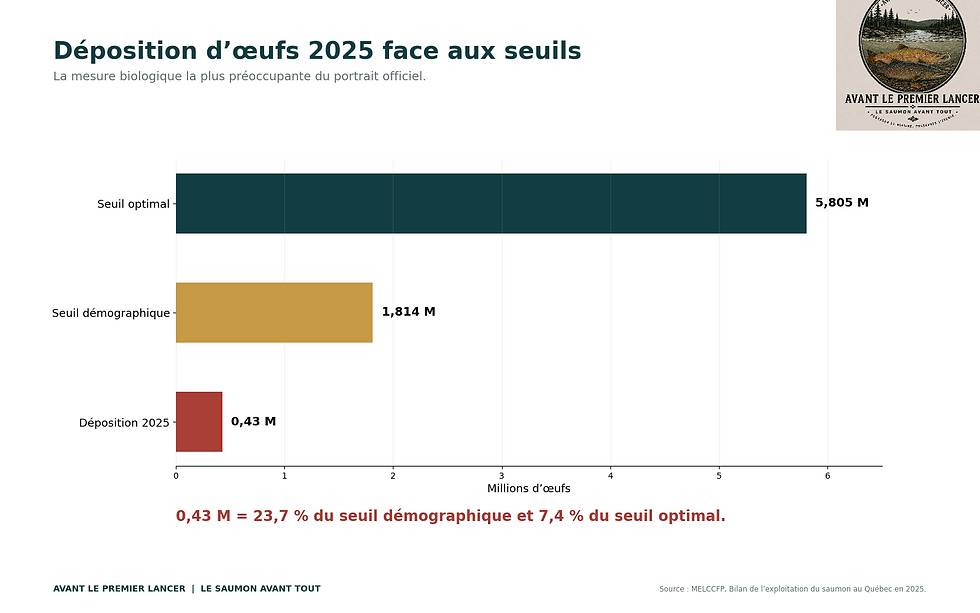
The official figures estimate the laying of 2025 at 0.43 million eggs .
The conservation references for the Rivière aux Rochers are as follows:
demographic threshold: 1.814 million eggs ;
Optimal threshold: 5.805 million eggs .
The 2025 filing therefore corresponds to only:
23.7% of the demographic threshold ;
7.4% of the optimal threshold .
These results should not be automatically projected to 2026. The cage count confirms the number of fish that passed, but not their sex, their survival to spawning, their reproductive contribution, or the final deposition of eggs.
Without this information, it is premature to present 2026 as the proven start of a recovery.
What needs to be measured before talking about recovery
Biological recovery cannot be demonstrated by a single annual improvement. It would be necessary to observe, in particular:
several consecutive years of increase in large spawning salmon;
an egg deposition that is sustainably approaching the demographic threshold;
a measured improvement in fry and parr densities;
an increase in smolt production;
improved survival between egg, smolt and adult return;
better return rates from the sea per cohort;
habitat restoration results supported by before-and-after monitoring and, ideally, by control sites.
The currently available data do not allow us to attribute the 2026 increase to habitat interventions. Nor do they demonstrate a lasting improvement in recruitment or marine survival.
Set the record straight
The title "A Better Season on the River of Rocks" isn't strictly wrong. The 2026 season is indeed better than the 2025 season.
The problem lies in the framing:
the total 2025 used by RiverNotes does not correspond to the official total;
the increase depends mainly on the madeleines;
the number of large salmon increases by only eight individuals;
The upstream migration remains far below historical averages;
No complete reproductive data are yet available for 2026.
Good news should be able to withstand a full portrait. Otherwise, it's not yet a summary: it's just a framing.
Rigour does not require denying the observed improvement. It requires measuring it with the right denominator, the right historical series, and the right biological indicators.
2026 is an improvement. It is not yet a recovery.

Sources
Ministry of the Environment, the Fight Against Climate Change, Wildlife and Parks. Review of Salmon Exploitation in Quebec in 2025 , table "Summary of Sport Fishing from 1984 to 2025 on the Rivière aux Rochers", pages 164–165. https://bibliotheque.cecile-rouleau.gouv.qc.ca/documents/archives/pgq/L6G48_B54/L6G48_B54_2025.pdf
Atlantic Salmon Federation. RiverNotes — September 3, 2026 , section “A Better Season on the River of Rocks”. https://www.asf.ca/rivernotes-september-03-2026/
Final count 2026 communicated after the closure of the cage: 137 grilse, 79 large salmon, total of 216. This breakdown had not yet been spotted in an official publication of the MELCCFP accessible online at the time of writing.
Government of Quebec. Atlantic Salmon Management Plan . https://www.quebec.ca/agriculture-environnement-et-ressources-naturelles/faune/gestion-faune-habitats-fauniques/gestion-especes-fauniques/plans-gestion/saumon-atlantique


Comments